
Documented Case: An International Patient Visit in Shenzhen's Public Reporting
Using official reports from the Shenzhen Health Commission and Peking University Shenzhen Hospital, this case note sets out the booking, registration, language support, payment, and report steps. Process only; no hospital recommendation or clinical claim.
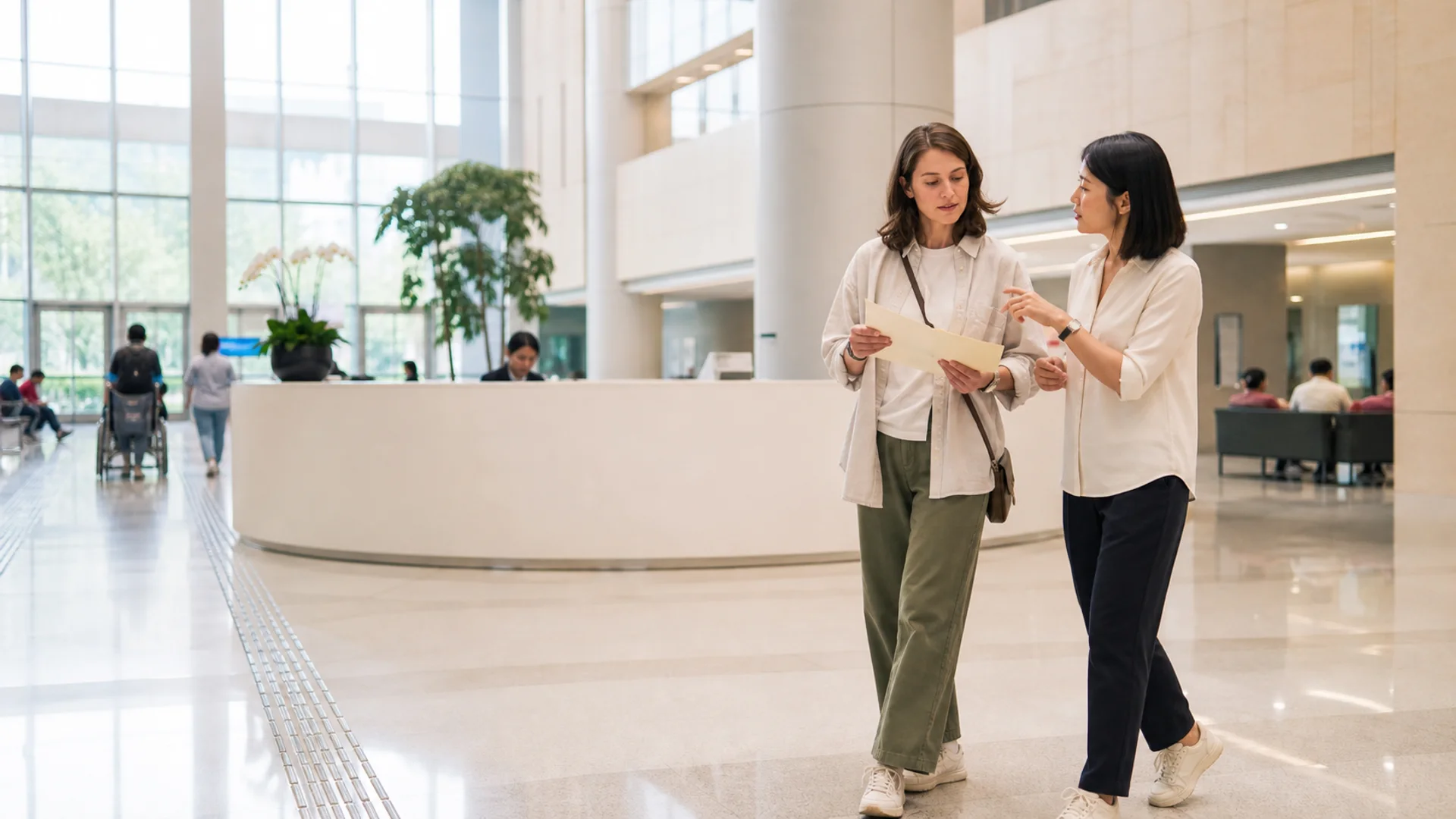
Summary: In January 2026, the Shenzhen Municipal Health Commission and the Peking University Shenzhen Hospital website reported on an overseas visitor who had an imaging examination at the hospital's international medical department. The public reports describe a one-stop service covering booking, registration, consultation, examination, payment, pharmacy, and report collection, plus a bilingual volunteer team. This note organises the administrative steps only.
Whether an international patient's visit runs smoothly often depends on five administrative points: booking, registration, language, payment, and report collection. A public report offers one verifiable sample. This article uses the official reports from the Shenzhen Municipal Health Commission and Peking University Shenzhen Hospital, separates the facts that can be checked from the parts the reports do not cover, and avoids turning one person's experience into a general conclusion.
What is the public source for this case?
The sources are matching reports published on 10 January 2026 by the Shenzhen Municipal Health Commission and the Peking University Shenzhen Hospital website, both publicly accessible.
The reports describe an overseas content creator who had an imaging examination at the hospital's international medical department. To protect personal information, this article does not reproduce the person's name, the imaging content, or the specific fee; it keeps only facts related to the administrative process. The original reports are linked at the end.
The case shows only what one hospital publicly described at one point in time. It does not mean every hospital offers the same arrangements, and it is not a recommendation, ranking, or statement of partnership.
Which administrative steps do the reports describe?
The reports say the international medical department provides one-stop service covering booking, registration, consultation, examination, payment, pharmacy, and report collection.
Broken down, the reported elements are:
| Step | What the public report says | What it means for a visitor |
|---|---|---|
| Booking | The international department offers one-stop service and receives international patients | The booking channel and available departments must be confirmed with the hospital |
| Registration | The department opens a patient record using identity documents such as a passport | The name spelling should match the passport |
| Consultation | The one-stop process includes consultation and examination | The department and sequence are set by the hospital |
| Payment | Commercial health insurance, overseas medical insurance, or self-payment is accepted | Whether an insurer can settle must be confirmed with the hospital and the insurer |
| Pharmacy | The one-stop process includes medicine collection | Whether medicine is collected in the hospital pharmacy follows the prescription |
| Report | The one-stop process includes report collection | Time and method follow the hospital's notice |
The table reorganises only what the reports already state. It adds no detail the hospital did not publish.
How is language support provided?
The reports say the hospital has run a bilingual volunteer team since 2013, helping international patients with registration, consultation, payment, pharmacy, and examinations; the team includes members who speak less common languages.
The public information also says the team is made up of medical staff, graduate students, and outside volunteers. For a visitor who does not speak Chinese, this kind of support mainly addresses process communication: where to register, which department comes next, where the payment window is, and when the report can be collected. It is not the same as medical interpretation, and it does not replace the physician's explanation of care.
The reports do not say whether this visitor used the volunteer team or which language was used. It therefore cannot be assumed that every international patient automatically receives interpretation. A visitor who needs language support should ask at the time of booking and confirm what the support covers.
What do the reports not say?
They do not say how this visitor booked, whether interpretation was used, how payment was made, or who explained the report.
The limits of a public case should be explicit:
- The booking channel and waiting time are not disclosed, so the report cannot be used to estimate appointment times at other hospitals;
- The use of interpretation is not described, so language service cannot be assumed to be a default arrangement;
- Payment method and insurance settlement are not described, so the report says nothing about cost levels;
- Diagnosis, treatment, and examination results are outside the report's scope, so it is not a source on outcomes.
Marking these gaps is more useful than filling them with assumptions. A visitor planning a trip should rely on what the target hospital publishes now.
What can a visitor planning care in China take from it?
Five items can be confirmed in advance: booking channel, identity documents, payment method, language support, and report collection. Confirming them reduces uncertainty on arrival.
In practice:
- Confirm the booking channel through the hospital's official website or phone line, not through verbal promises from an unofficial intermediary;
- Confirm which identity document is needed, usually a passport, with the name spelled as it appears there;
- Confirm payment methods and whether your insurer can settle at that hospital, and which documents are required;
- Ask whether language support is available and which steps it covers;
- Confirm when and how the report is collected, and whether the patient must attend in person.
If in-hospital assistance with queuing, wayfinding, and document organisation would help, see [how hospital accompaniment works](/en/how-it-works). The general outpatient sequence is described in what to expect at a hospital visit in China; city and hospital information for Shenzhen is in the Shenzhen hospital visit guide. Other questions are collected in the international patient FAQ.
What can this case not show?
It cannot show examination results, a diagnosis, or a treatment outcome, and it does not prove that one hospital is better than another. It also cannot be used as a basis for costs, waiting times, or success rates.
When using a public case, three kinds of information should be kept apart:
- Verifiable facts: the service arrangements and process steps the report explicitly states;
- Individual experience: the visitor's subjective impression, which does not generalise to everyone;
- Undisclosed information: booking method, payment details, and interpretation use, which the report does not describe.
This article uses the first kind, does not quote the second, and labels the third. That keeps faith with the public source and avoids presenting one case as a general rule.
Reference sources
- Shenzhen Municipal Health Commission, "Overseas blogger flies to Shenzhen for care: PKU Shenzhen Hospital's international medical service", 2026-01-10, accessed 2026-10-22: https://wjw.sz.gov.cn/wzx/content/post_12599855.html
- Peking University Shenzhen Hospital, "Overseas blogger flies to Shenzhen for care", 2026-01-10, accessed 2026-10-22: https://www.pkuszh.com.cn/hzb_yydt_yyxw/010013600009044.html
Medical information notice: This article organises administrative steps from public reporting only. It is not medical advice, a hospital recommendation, or a statement about outcomes. Examination, diagnosis, and treatment should follow the medical institution and its licensed physicians.
Prepared by the Medical Escort Team, Liaoning Taimu Business Technology Co., Ltd. Public sources checked 2026-10-22.
Sources and verification
Official references reviewed for this guide. Policies, schedules, eligibility, and hospital services may change; confirm current details with the responsible authority.